Cat Nutrition, Cats
Cat Nutrition: Why Meat Content Matters (And How Popular Brands Compare)
Sep
Cats aren’t like dogs when it comes to diet — they’re obligate carnivores, meaning their bodies are built to run on meat, not a general omnivore’s mixed diet. That single fact shapes almost everything about what makes a good cat food, and it’s exactly why meat content is one of the most important things to check on a label. Here’s why it matters, and how some popular supermarket brands actually compare to higher-meat-content alternatives.
Why Cats Need High Meat Content
Unlike dogs, cats have specific nutritional requirements that can only be properly met through animal-based ingredients:
- Taurine — an essential amino acid cats cannot produce in sufficient quantities themselves. It’s found naturally in animal tissue, and a deficiency can lead to serious heart and eye problems over time.
- Arachidonic acid — an essential fatty acid that, unlike in most other mammals, cats can’t synthesise from plant-based fats. It has to come from animal fat directly.
- Preformed vitamin A — cats can’t convert plant-based beta-carotene into usable vitamin A the way dogs and humans can, so they rely on animal sources to meet this need.
- Minimal carbohydrate requirement — cats have limited carbohydrate metabolism and no real biological need for it. Diets heavy in cereals and fillers aren’t toxic, but they’re not what a cat’s digestive system is designed around either.
In short: a cat fed a diet genuinely built around meat is being fed in line with its actual biology. A diet padded out with cereals and vague “derivatives” is still nutritionally complete on paper, in most cases, but it’s leaning on a different set of ingredients to get there.
Understanding the Label
UK pet food labelling can make it tricky to know what you’re actually buying. A few terms worth understanding:
- “Meat and animal derivatives” is a legally permitted, broad category that can include a wide range of animal parts and doesn’t have to specify the source animal or exact meat percentage.
- A named meat percentage in brackets, e.g. “chicken (17%)”, tells you how much of that specific ingredient is in the product — this is far more informative than a vague overall category.
- Ingredients are listed by weight, so the order matters — if cereals appear before meat, they make up more of the recipe.
How Popular Brands Compare — Dry Food Only
To keep the comparison exact, here’s a like-for-like look at dry food only across four brands, using a representative recipe from each range. Individual recipes within a range vary, so always check the specific product you’re buying — but this gives an accurate snapshot of the real difference between typical supermarket dry food and higher-meat-content alternatives.
| Brand (Example Dry Recipe) | Named Meat Content | Crude Protein | Crude Fat | First Ingredient | Grain-Free |
|---|---|---|---|---|---|
| Whiskas (1+ Dry, Chicken) | Meat & animal derivatives (unspecified overall %), of which chicken 4% in the brown kibble | 30% | 11.5% | Cereals | No |
| Purina ONE (Chicken, Adult) | Chicken 17% (incl. bone, meat, skin) | 34% | 14% | Chicken | No |
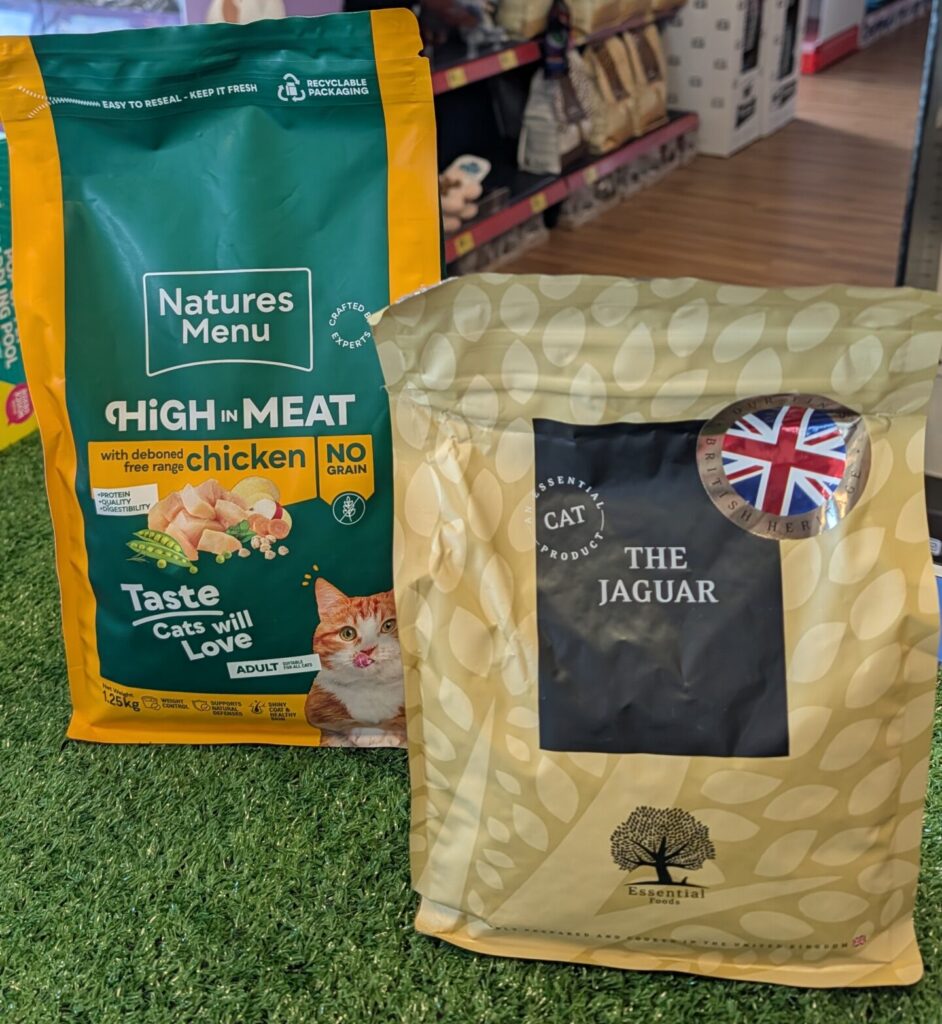
| Nature’s Menu (High in Meat, Chicken) | Deboned chicken 30% + dried chicken protein 21% (51%+ named chicken) | 38% | 15% | Deboned chicken | Yes |
| Essential Foods (The Jaguar) | 95%+ named meat, fish & egg (duck, chicken, salmon, trout) | High (check pack for current exact %) | Check pack for current exact % | Duck | Yes |
Figures taken from current UK packaging and manufacturer product pages for the specific recipes named above. Formulations do change over time, and other recipes within the same range can differ meaningfully — always check the pack you’re actually buying for the current figures.
What This Actually Means for Your Cat
None of this means supermarket brands are unsafe — they’re formulated to meet the required nutritional standards, and cats can and do live on them. But there’s a meaningful difference between a food that hits its nutrient targets partly through named, identifiable meat, and one that relies more heavily on cereals, vague “derivatives,” and added sugars to get there.
Higher-meat-content, grain-free foods like Nature’s Menu and Essential Foods tend to offer:
- More protein sourced directly from named meat, rather than a mix of animal and plant-based protein.
- Less reliance on cereals and fillers cats have limited use for.
- Greater ingredient transparency — you can see exactly what’s in the bowl, not just a broad category.
Making the Switch
If you’re thinking about moving to a higher-meat-content food, introduce it gradually over 7–10 days, mixing increasing amounts in with the current food to avoid digestive upset. And as always, if your cat has a diagnosed health condition — kidney disease in particular often requires a specific protein and phosphorus balance — check with your vet before changing their diet.
Want help choosing a higher-meat-content food that suits your cat? Pop in store and we’re happy to talk through the options.
